Be yourself; Everyone else is already taken.
— Oscar Wilde.
This is the first post on my new blog. I’m just getting this new blog going, so stay tuned for more. Subscribe below to get notified when I post new updates.
Be yourself; Everyone else is already taken.
— Oscar Wilde.
This is the first post on my new blog. I’m just getting this new blog going, so stay tuned for more. Subscribe below to get notified when I post new updates.
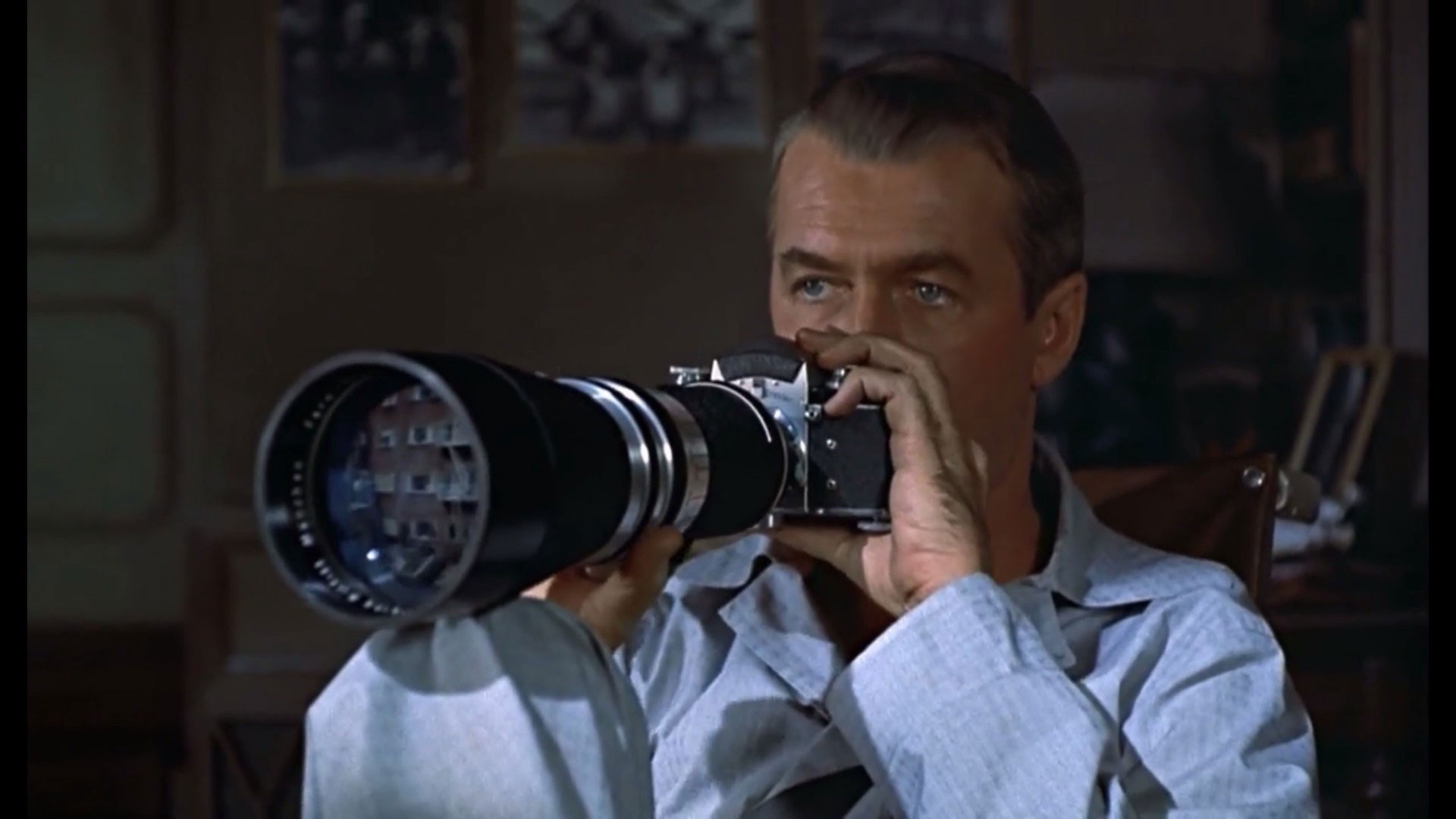
Rear Window was an amazing film by Alfred Hitchcock that really hits the idea of whether voyeurism is a good or bad thing. Although Jeff solves the mystery of Thorwald being a murder, he is hit with the complications of Stella and Lisa telling him how wrong watching other people are. This was also the only movie I could think of where we know just as much as the character does almost as if we are sitting in his apartment with him the entire time.
One thing I would like to speak about in this film that I found fascinating and revolutionary was the views through the camera lens. This was so ahead of its time and really did change a lot of the ways that . One point about this is that it gives the viewer the feel of being the person behind the lens or scope. The viewer almost feels as if they’re the one in charge and are begging to see more with the lens. One movie I can relate this too although a completely different genre is Saving Private Ryan. There is the scene in the movie where you are looking through the scope of a sniper and finding enemies as if you were the soldier in the position. Saving Private Ryan was the first time I had seen something like this ever done, and now I know where they got it from.
One last point on Rear Window is the cinematography. Alfred Hitchcock does an outstanding job of using lighting and shadows throughout the entire film. Now the fact that this film is a mystery and thriller the lighting is very important for certain aspects to keep that mystery from unraveling to fast, as well as keeping the viewer and the character Jeff able to solve it. The lighting in the film is always picking up on important messages, signs, and symbols throughout it. Also at the end of the film when Thorwald finally comes to get Jeff you only see his shadow at first. This keeps this last scene so suspenseful and thrilling due to not knowing if its him or someone else.


Us was a very suspenseful and thrilling horror movie with many aspects that made it different from any normal one. The film suggests many different themes throughout it, one being that the evil we usually portray in the world or movies is not real. The real evil in the world is us as people. We are the ones who create all of the hateful crimes and madness in this world and we are also the only ones that can stop ourselves. By this I mean that you cant change the world unless we change ourselves. Overall the movie I believe was a masterpiece and served as showing many hidden themes of what happens in our societies.
One scene I found ultimately fascinating was the scene of Jason playing with his dark half in the closet. The lighting is tremendous in this scene, the only light is from the flame of the lighter that the child plays with. The filming also switches back and forth from both of their perspectives as well as a view of both of them from the side to see each of them. Throughout this scene the sound is made from both the children’s breathing, as Jason gets more nervous his breathing gets heavier. Usually kids are also not meant to play with lighters or fire due to it being dangerous but this dark half of Jason does not know that due to the way he has grown up in anarchy.
I think this scene also represents the fact that children have the sense of innocence to them, but could also be dangerous. What I mean by dangerous is that with older generations shedding influence down on our youth this could make them just as dangerous or lethal as an adult. If an adult tells a kid that doing something wrong is right, they will do that thing while not knowing the wrongness of it or consequences. Having a child who knows nothing of consequences or right or wrong could being looking at life through a completely screwed up lens. An example of this is children who grown up around terrorists. They are told that if they commit the most horrific acts known to man to other humans that they will be rewarded for it. This theme I believe runs throughout the movie and in other scenes.
/cdn.vox-cdn.com/uploads/chorus_image/image/63339567/MV5BMTk0OTY2MDIwMl5BMl5BanBnXkFtZTgwMzY0Nzg2NzM_._V1_SX1777_CR0_0_1777_948_AL_.0.jpg)

Mulholland Drive was a terrific movie that had a lot of jump scares and kept you on your toes the entire time. I suggest you don’t watch this before bed as I did or you wont get much sleep. There is such a feeling of dread throughout the entire movie as well. The film represents how things aren’t scary on the surface but there is an invisible horror that kills you deep inside and causing serious anxiety. The movie gives a real interpretation of mental suffering and I think David Lynch did an awesome job.
The last five minutes of the film feels like something out of a Nightmare on Elm Street movie with Freddy Krueger. The lighting of the beginning of the scene is almost identical to what goes on in A Nightmare on Elm Street, it has the dark black and red lighting with the thick smoke blowing from behind Bonnie Aarons character the bum. This lighting suggests a pain or suffering as it does in the Freddy Krueger movies and even suggests a matter of feeling stuck in this horrible place. Then the scene cuts to Diane on her couch and she looks awful and seems to be struggling to keep herself awake. Then she begins hear loud knocking at the door and begins to hallucinate the old people again. As she runs away from the old people toward the bedroom it goes back and forth of shots of the old people chasing and her running. As this occurs the lighting surrounding them gives off the aura of lightning and thunder. Which suggests even more that it is almost dream like because all of this badness occurring at once could only be in a dream. Then she hits the bed and shoots herself and a big cloud of black smoke fade over the screen. Then the scene begins to fade out between several shots of betty and rita mixed in with the back drop of the city with a sad and gloomy soundtrack behind it. This suggests that the city literally takes the lives of talented young people without any remoras, because the City of Angeles thrives on innocence.
I believe the knocking on the door represents remorse trying to creep inside Dianes conscience, and it finally does. This knocking reminds her of all the people she disappointed, her failed relationship, failed career, and just all the wrong she has done. These final knocks are the ones that finally drive her over the edge to the point where she is to tormented to go on. These feelings are represented in the old people and they literally chase her to the bed and causes her to commit suicide.

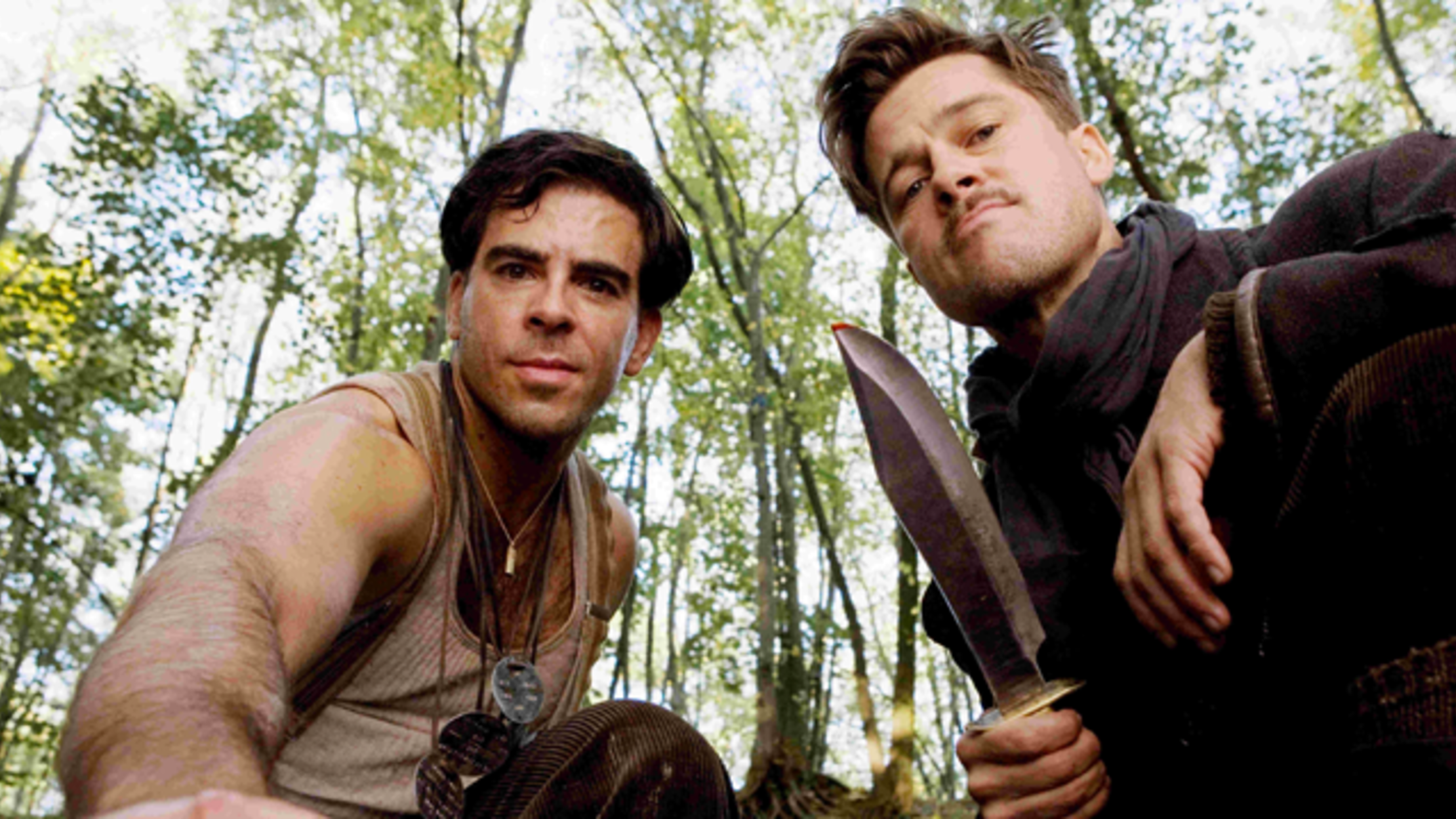
Quentin Tarantino’s film, Inglorious Bastards was a spectacular masterpiece overall in my opinion. From the costume design, filming techniques, and sets it was all done in fascinating way. Quentin Tarantino truly has his own touch that he puts on his films, as well as a spin on actual events that happened in history. It was incredible the way he split the 5 interrelated parts together in the film. This almost gave it the feeling of being a book split into chapters.
In mostly all of Quentin Tarantino’s films he has moments where scenes are just absolutely ridiculous, insane or even funny in a disturbing way. One scene that comes to mind from Inglorious Bastards is the death of Adolf Hitler. Although this is not meant to be an actual comedic scene due to hundreds of people being killed. The death scene is clearly very fake with Hitlers face almost being represented as a prop. His face rips off in the most fictional way and the scene is longer than usual for the audience to watch Hitlers face get ripped to pieces. Another scene from the film that I believe has an intense Quentin Tarantino feel to it is the scene at the end of Brad Pitt and B.J. Novak carving the swastika into Christoph Waltz head. The camera is facing up at the two from the perspective of Waltz. Making it seem as if the audience is the one having this done to them.
Something else that intrigued me with Inglorious Bastards was the different camera angles. Tarantino always puts you in a place that makes the audience feel as if they are apart of the film and not just watching. One scene that comes to mind is when the camera is placed under the floor boards with the hiding jewish family in the first scene. This scene is so intense and riveting and almost makes the audience stay silent feeling like you will be caught as well if you make a peep. Another scene that caught my eye was the scene when Eli Roth and Omar Doom are shooting up the theater. This scene has such an old fashioned gangster film feel to it and almost scarface like feel to it. This is due to the long shot of Omar shooting with that angry face on.
Overall Inglorious Bastards is another fine example of Tarantino’s love for film and doing it in an unusual yet brilliant way. No one is safe in his films no matter how important the character is or famous the actor is. His style of filming is casting crazy characters, having very intense violence, and adding some sick humor in to top it off.
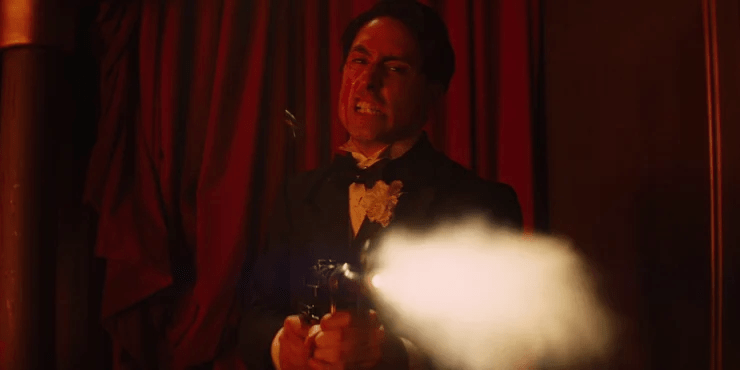
Scene Of Omar shooting up theater
Cache so far was my favorite film that we had watched for class. It was suspenseful, thrillin and kept you from turning you head away from the screen at all times, due to missing a part that would tie the entire story together. Except even after the movie ends I’m still unsure of who was sending the pictures and tapes. Although I wish to know who exactly was terrorizing the family I like to keep myself guessing.
The filming of the movie was a bit different then the ones we had previously watched in class. Many of the scenes are shot in a way where the camera is still at all times without any movement. The camera faces one area or person and stays very still for usually an entire scene without changing any perspective. As an audience member some of it feels almost awkward in some instances as well as almost watching from inside a window to the outside. The movie actually opens and ends this way and I’m curious why the director chose to do this, but i found it fascinating. Another filming technique I found interesting in the film was when Georges would be on tv for his interviews. You can tell the director lowered the quality of the camera to appear as if the filming was done by an older fashion television camera. This is something that just caught my eye that I thought was really cool.
Beyond this something I found very interesting was the fact that there is really no soundtrack in the entire film. The only background noises in the entire film are other character speaking, or the sound of the city noise. This felt weird to me due to almost every film I’ve seen having some sort of diegetic sound. But this film was all diegetic which was new to me.
Do The Right Thing is a dark comedy that takes place in an urban area in the Bronx. The film starts out being very funny, but as the film progresses toward the end it becomes very dark in manor. The film expresses many stereotypes and racist thoughts about the races that make up the neighborhood very openly. This is something that tends to make the audience feel uncomfortable with watching or even poking fun at. But overall I believe that the film was very well made and at the time was definitely a big eye opener for the public to see.
But one thing that intrigued me about the movie was the way it was filmed in just a period of one day. It goes through so many characters lives throughout the neighborhood and how they all played an important role in the community and the narrative of the film. At one point while watching the film I was curious where this movie was going and how it would all add up in the end when they were just jumping from scene to scene with different people in each one. But in the end it all added up and you got to see why each person was important in their role.
Another thing I found fascinating was the fact that the movie has the reoccurring theme of not fighting violence with violence and how it will not solve anything in the end. But then in the end of the film Mookie just gives up all hope and throws the trash can through Sals window and an entire riot breaks out causing absolute hell to break loose.
My last thought on the film has to do with how many times throughout the movie the fourth wall was broken from the characters. In one scene specifically Radio Raheem breaks the fourth wall for an entire scene. He is telling Mookie what his new rings mean but is looking directly into the camera. This is something I found very fascinating because it feels as if he is talking to the audience and we are almost a part of the community. What he says in this scene also plays into the end of the film, he says how with love and hate there is always static, and one is always fighting the other. Meaning that with both love and hate their is always going to be turmoil, which happens in the end when Raheem dies.
Overall 400 Blows was a terrific and well made movie. The film follows a young troubled boy Antoine who just can’t seem to stay out of trouble. It shows you his life at home, school, and life outside with his friend René. In all three aspects he seems to find a way to get in trouble or do something he shouldn’t be doing. He has no role models in his life to show him the right way or to do good which is a huge hardship on him. The ending of the film had me a little bit confused and I am still trying to depict what it means.
But some aspects of the film i found fascinating was the soundtrack that goes along with the film, which makes each scene in many ways. From the chaotic music being played while he is on the amusement ride in the beginning, to the sad music being played while he is being taken away in the police truck. Another well done aspect of the film was the cinematography. There are so many scenes in the film of following two or more characters around the city, and Henri Decaé does an amazing job of cutting to different angles while continuing dialogue.
One scene in the movie I found very fascinating was in the beginning when the camera was facing the front of the classroom where ‘Petite Feuille’ (The French teacher) was standing from the perspective of the children. The way the camera is angled you can see the entire classroom, the teacher teaching, Antoine cleaning the side board, and the children at there desks. This gives you a good glimpse of everything that is going on in the room as well as what some people are not aware of. While the teacher had his back turned the students would mimic him and gesture things with him being unaware of them, but us the audience is aware as almost being another students in the classroom. Then when the teacher confronts the class and yells at them, then he proceeds to chucks a piece of chalk right at the camera making it feel even more like your are apart of the classroom and not just an audience member.
Also one aspect of sound that stuck out to me in the film, was when Antoine is with watching the newsreel with René you could tell that the sound of his bubble gum popping was not filmed on the actual set of the film. To make this sound effect they used a soundscape which we had learned about in class called foley. This gave it that loud almost cartoon like pop sound to it.
This is an example post, originally published as part of Blogging University. Enroll in one of our ten programs, and start your blog right.
You’re going to publish a post today. Don’t worry about how your blog looks. Don’t worry if you haven’t given it a name yet, or you’re feeling overwhelmed. Just click the “New Post” button, and tell us why you’re here.
Why do this?
The post can be short or long, a personal intro to your life or a bloggy mission statement, a manifesto for the future or a simple outline of your the types of things you hope to publish.
To help you get started, here are a few questions:
You’re not locked into any of this; one of the wonderful things about blogs is how they constantly evolve as we learn, grow, and interact with one another — but it’s good to know where and why you started, and articulating your goals may just give you a few other post ideas.
Can’t think how to get started? Just write the first thing that pops into your head. Anne Lamott, author of a book on writing we love, says that you need to give yourself permission to write a “crappy first draft”. Anne makes a great point — just start writing, and worry about editing it later.
When you’re ready to publish, give your post three to five tags that describe your blog’s focus — writing, photography, fiction, parenting, food, cars, movies, sports, whatever. These tags will help others who care about your topics find you in the Reader. Make sure one of the tags is “zerotohero,” so other new bloggers can find you, too.

 Brendan Mannix Film Blog